
How Does Couples Therapy Work? A Step-by-Step Guide to What Really Happens
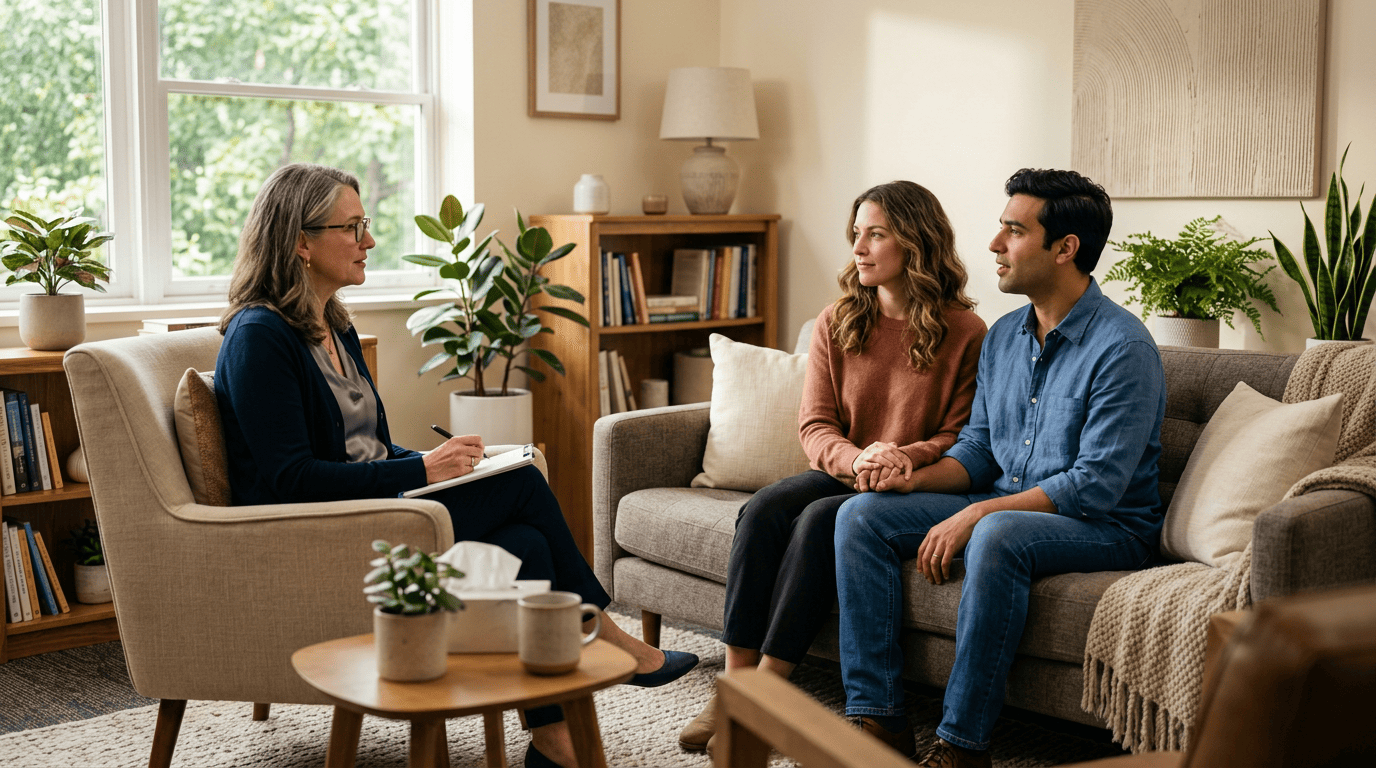
Couples therapy — also called marriage counseling or relationship counseling — is a specialized form of psychotherapy where a licensed therapist guides both partners toward better communication, deeper understanding, and lasting change. If you’re unsure whether it could help your relationship, an AI relationship advisor can be a useful first step to explore your situation before or between sessions. Research consistently shows that couples therapy can benefit relationships at any stage — not only those in crisis.
Contrary to a common misconception, this form of relationship counseling is not a last resort. Around 70% of couples report meaningful improvement after completing therapy, according to data cited by the American Psychological Association. This guide walks through the full process: from the first assessment session to the techniques used, the approaches that have research behind them, and realistic expectations for how long it takes.
What Is Couples Therapy?
Couples therapy is a type of psychotherapy designed to help two people in a relationship improve how they communicate, manage conflict, and connect emotionally. A licensed therapist — typically a marriage and family therapist (MFT), psychologist, or licensed professional counselor — guides sessions using evidence-based methods. The practice didn’t reach widespread acceptance until the 1980s, when research began establishing it as a distinct and effective discipline.
What makes it different from individual therapy
In individual therapy, one person is the client. In couples therapy, the relationship itself becomes the third entity in the room. The therapist simultaneously balances the needs of both partners and the relationship as a whole — a dynamic that requires a specific skill set. A couples therapist does not take sides or declare one partner “right.” Instead, they identify how each person’s behavior contributes to shared problems. Relational science has firmly established that both partners play a role in most relationship conflicts.
Another distinction: couples therapy can sometimes involve brief individual sessions alongside joint ones. In the Gottman Method structure, each partner meets separately with the therapist during the assessment phase — not to keep secrets, but to share perspectives they might filter in front of their partner.
Couples therapy vs. couples counseling
These terms are used interchangeably in everyday conversation, but there is a meaningful clinical difference. Couples counseling is short-term — typically focused on one specific, current problem and often completed in six sessions or fewer. Couples therapy is a deeper process. It explores the roots of dysfunctional patterns, helps partners understand their own emotional needs, and often works to undo damage that has accumulated over years. The average course of couples therapy runs 12–16 sessions.
Who benefits from couples therapy
| Situation | Can couples therapy help? |
|---|---|
| Frequent arguments that go nowhere | Yes — a core use case |
| Emotional distance or disconnection | Yes — especially EFT |
| Trust issues or recovering from infidelity | Yes — structured approaches exist |
| Major life transition (new baby, job loss) | Yes — preventative and reactive |
| Sexual difficulties | Yes — specific variations available |
| Healthy relationship wanting to grow stronger | Yes — preventative use shows strong outcomes |
| One partner has depression or PTSD | Yes — couple-based approaches help individual conditions too |
| Active abuse or manipulation | No — individual safety must be addressed first |
The Couples Therapy Process: What Happens Step by Step
The process of couples therapy is more structured than most people expect. Rather than two people venting at each other while a therapist listens, good couples work follows a deliberate sequence — assessment first, goals next, then active skill-building with practice between sessions.
“Couples wait an average of six years before they make the decision to seek out couples therapy. That’s six long years of beating your heads against the wall hoping for a different outcome.”
Dr. John Gottman, The Gottman Institute
- Initial assessment (sessions 1–3). The therapist meets with both partners to understand relationship history, communication patterns, and the concerns that brought them in. In many approaches, the therapist also conducts brief individual sessions with each partner — a chance to share things they’d filter in front of their partner, and to build individual trust with the therapist. The Gottman Method formalizes this as sessions 2 and 3 (“vent sessions”), followed by a joint evaluation in session 4.
- Goal setting. The therapist helps the couple collaboratively define realistic, measurable goals. These might include improving communication during conflict, rebuilding trust after a breach, increasing emotional intimacy, or navigating a specific life change. Clear goals give sessions direction and create a way to measure progress over time.
- Active sessions — learning and practicing. Regular sessions typically last 50–90 minutes. Each session begins with a check-in on progress since the last meeting, then addresses a specific issue, practices a technique, or works through a structured exercise. Sessions usually end with a summary of key insights.
- Between-session practice (homework). Therapists assign exercises to reinforce what was learned in session: communication drills, journaling prompts, gratitude practices, scheduled “date nights,” or targeted reflection tasks. Completing this homework is one of the strongest predictors of lasting improvement — the real change happens in the week between sessions, not just the 50 minutes in the room.
Types of Couples Therapy: The Four Main Approaches
Most couples therapists are trained in multiple modalities and draw flexibly from different approaches depending on what a particular couple needs. The four most widely used evidence-based methods:
| Approach | Core focus | Best suited for | Long-term success rate |
|---|---|---|---|
| Emotionally Focused Therapy (EFT) | Attachment bonds, emotional security | Emotional disconnection, fear-based patterns | Up to 75% |
| Gottman Method | Communication patterns, friendship, conflict management | Research-based skill building | Strong research base |
| Cognitive Behavioral Therapy (CBT) | Negative thought patterns, behavioral cycles | Conflict driven by misinterpretation | Well-established |
| Imago Relationship Therapy | Childhood wounds, partner selection patterns | Deep-rooted recurring conflict | Widely practiced |
Emotionally Focused Therapy (EFT)
EFT is grounded in attachment theory — the framework developed by John Bowlby describing how humans form emotional bonds with caregivers. Applied to adult relationships, EFT treats emotional disconnection as the root cause of most recurring conflict. When the bond between partners feels threatened, one person may escalate (pursue, criticize, demand) while the other withdraws — and both responses make the disconnection worse.
The therapist helps partners access and express the vulnerable feelings that lie beneath surface conflict: fear of being unloved, of abandonment, of not mattering to the other person. When one partner reveals that vulnerability, it typically stirs a compassionate response in the other — and that exchange begins to rebuild the bond. EFT has shown long-term success rates of up to 75%, making it one of the most research-backed approaches in the field.
The Gottman Method
Developed by Drs. John and Julie Gottman after more than four decades of research studying what distinguishes relationships that thrive from those that fail, the Gottman Method centers on a few key ideas: negative emotion has an outsized power to damage a relationship; partners need to make frequent “bids for connection” and repair damage when bids are missed; and deep knowledge of your partner’s inner world — what Gottman calls a “love map” — is foundational to intimacy.
The method also identifies The Four Horsemen — criticism, contempt, defensiveness, and stonewalling — as the most destructive patterns in couple communication. Recognizing these patterns and replacing them with healthier responses is central to Gottman-trained therapy.
CBT and Imago Therapy
Cognitive Behavioral Therapy for couples works by helping partners identify how their interpretations of each other’s behavior — not just the behavior itself — drive conflict. Someone who reads a partner’s silence as rejection will respond very differently than someone who reads it as needing space. CBT helps both partners examine those interpretations and develop more accurate, less reactive ones.
Imago Relationship Therapy takes a different angle: it explores the idea that we unconsciously choose partners who mirror traits of our early caregivers, seeking to heal old wounds through the relationship. Therapy involves structured dialogue — each partner speaks while the other mirrors back what they heard, validates the perspective, and expresses empathy. The goal is to transform recurring conflict into an opportunity for understanding and growth.
Techniques Used in Couples Therapy Sessions
Beyond the broader therapeutic approach, sessions draw on specific techniques — many of which also become homework. Here are the most commonly used:
Reflective listening. The listener hears what the speaker says, then repeats it back to confirm understanding — before responding. This slows down conversations that typically escalate, and ensures each partner feels heard rather than talked over.
I-statements. Shifting from “You never listen” to “I feel unheard when I’m interrupted” changes the dynamic from accusation to disclosure. Research shows this subtle shift in phrasing significantly reduces defensiveness and makes productive conversation more likely.
The Miracle Question. Developed by Steve De Shazer and Insoo Kim Berg as part of solution-focused therapy: “If you woke up tomorrow and your relationship problems were completely resolved, what would that look like?” The technique helps each partner articulate their ideal vision — and helps couples hear each other’s hopes instead of only each other’s grievances.
Eye contact exercises (gazing). Partners sit facing each other and maintain eye contact in silence for several minutes. Studies have found these exercises enhance emotional intimacy and connection. Sharing what came up during the exercise often surfaces feelings that are difficult to access through conversation alone.
Gratitude practice. Expressing gratitude to a partner triggers the release of oxytocin — sometimes called the “love hormone” — and promotes bonding. Daily gratitude practice is one of the most frequently assigned homework tasks, and its benefits are measurable in relationship research.
Does Couples Therapy Work? What the Research Shows
Couples Therapy Effectiveness — Key Research Numbers
The numbers are encouraging. Around 70% of couples report meaningful improvement in their relationship after completing therapy, according to research cited by the American Psychological Association. The American Association of Marriage and Family Therapists (AAMFT) reports that over 90% of couples surveyed said their emotional health improved after working with a relationship therapist. EFT specifically shows long-term success rates of up to 75% — meaning the improvements hold months and years after therapy ends, not just immediately after the final session.
What predicts success. Therapy is most effective when both partners are genuinely committed to the process, both are willing to be honest and vulnerable, homework is completed between sessions, and the couple starts early — before years of resentment have accumulated. The Gottman research finding that couples wait an average of six years before seeking help is significant: by that point, negative patterns are deeply entrenched and harder to reverse.
When therapy is less likely to help. If one partner has already decided to end the relationship and is attending only to satisfy the other, meaningful progress is unlikely. When active abuse or manipulation is present, the safety of the individual takes priority — couples therapy is not recommended in those situations, and individual support should come first. When both partners have fundamentally incompatible long-term goals, therapy may still serve a purpose — helping them separate thoughtfully rather than staying together in ongoing conflict.
How Long Does Couples Therapy Take?
The average course of couples therapy runs 12–16 sessions, typically held weekly at the start and lasting 50–90 minutes each. Some couples — particularly those dealing with one specific, bounded issue — notice meaningful change within 8–10 sessions. Complex situations, such as recovering from infidelity, longstanding dysfunctional patterns, or co-occurring individual mental health conditions, often require longer-term work.
Couples counseling (shorter-term, focused on a single issue) typically wraps up in 6 sessions or fewer.
Many couples also return for periodic “tune-up” sessions after completing an initial course — a few sessions per year to maintain gains and address new challenges before they become entrenched. This preventative use of couples work reflects how the field has evolved: therapy as ongoing relational maintenance, not just crisis intervention.
How Much Does Couples Therapy Cost?
In-person couples therapy typically runs $100–$200+ per session, with significant variation based on therapist credentials, location, and cost of living in the area. Many therapists offer sliding-scale fees for couples with financial constraints, and some community mental health centers provide lower-cost options.
Online couples therapy through platforms like Regain typically costs $70–$100 per week, billed weekly or monthly. A 2022 study published in Frontiers in Psychology found that virtual couples therapy delivered via video is as effective as in-person sessions for improving relationship satisfaction and mental health outcomes — making online therapy a genuinely equivalent option, not just a cheaper substitute.
Insurance coverage varies. Some plans cover couples therapy when one partner has a mental health diagnosis that is being addressed through the relationship work. It is worth checking with your provider directly.
Signs You May Benefit from Couples Therapy
Couples therapy isn’t only for relationships in acute distress. Some of the most consistent signals that it could help:
- Arguments repeat without resolution — you fight about the same things over and over
- You feel emotionally distant or disconnected from your partner
- Communication consistently escalates into conflict or shutdown
- Trust has been broken — by infidelity, deception, or repeated let-downs
- You’re navigating a major life transition: a new child, job loss, relocation, illness
- You’re considering separation or divorce but feel uncertain
- Your relationship is generally good, but you want to build stronger communication habits before problems grow
The earlier couples seek support, the better the outcomes. Many therapists and relationship researchers note that the couples who do best in therapy are not the ones in the deepest crisis — they’re the ones who came in before years of damage accumulated.